How Do You Measure the Size of a Frying Pan Accurately?
Measuring a frying pan’s size accurately is essential for choosing the right cookware that fits your stove and meets your cooking needs. Knowing how to measure a frying pan properly can save you from buying the wrong size. It’s a bit more nuanced than just guessing or using a ruler haphazardly.
If you don’t get the measurements right, you might end up with a pan that’s too big or too small, affecting your cooking experience. You’ll want to know the exact steps and tools required to guarantee your measurement is spot-on. This is especially important when dealing with different pan shapes, such as round or square.
Let’s explore the best ways to measure a frying pan accurately, ensuring you pick cookware that works perfectly for you.
Why Accurate Frying Pan Measurement Is Important
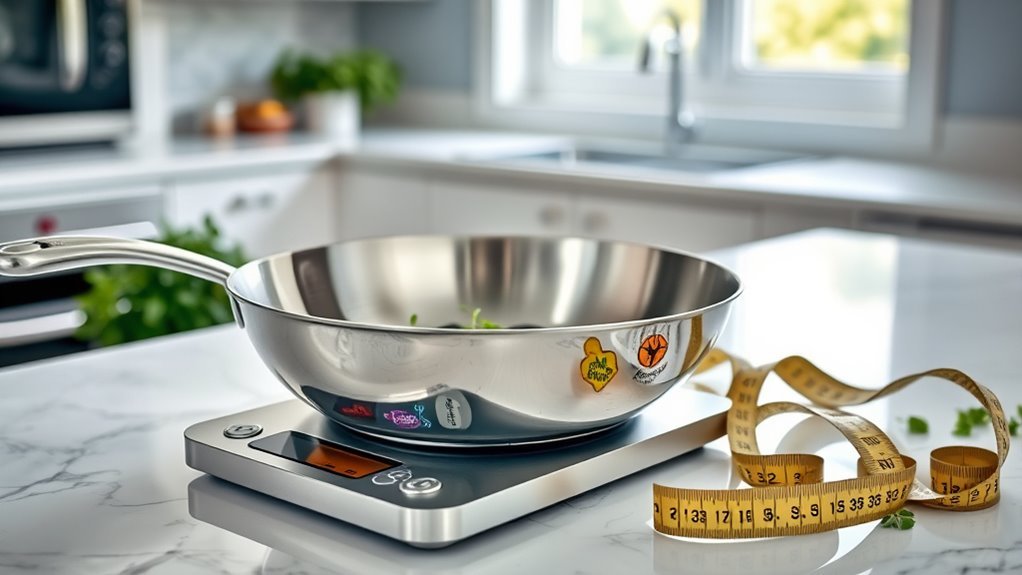
When you measure your frying pan accurately, you guarantee it fits your stove and storage space perfectly, preventing any inconvenience. Accurate frying pan measurement is essential for selecting the right pan size, especially the diameter, which directly affects heat distribution and sizing for cooking.
Using standard measurement techniques ensures you get reliable, uniform results when comparing different pans. Knowing your pan’s exact diameter helps with recipe adaptation and portion control, allowing you to cook consistently and avoid overcrowding.
Proper measurement also ensures pan compatibility with your cookware and oven, preventing wasted purchases or poor cooking outcomes. By focusing on precise measurement, you optimize your cooking experience, maintain efficiency, and avoid common issues related to mismatched pan sizes and improper heat use.
Tools Needed to Measure a Frying Pan
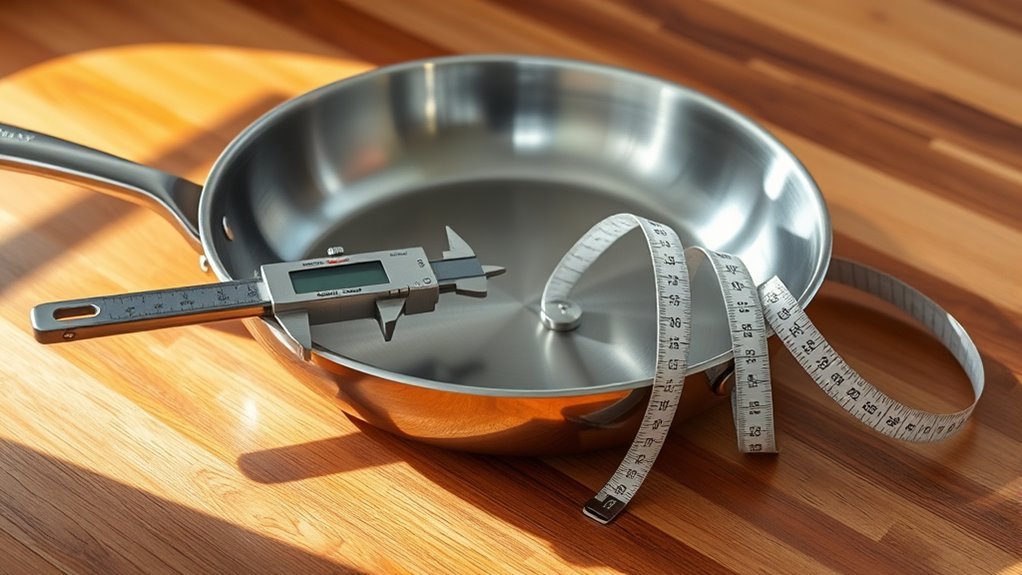
Accurate frying pan measurement starts with having the right tools on hand. You’ll need a flexible measuring tape or a rigid ruler to get an exact measurement of your pan size.
Begin measuring your frying pan accurately with either a flexible tape or a rigid ruler.
Place the pan on a flat surface to ensure stability and precision.
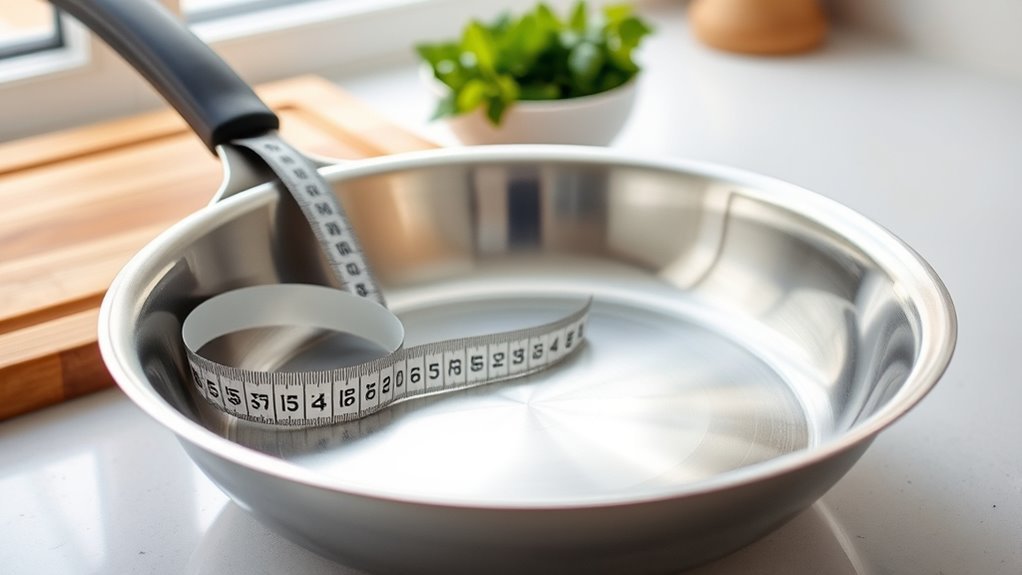
Measure across the inner rim at the widest point, passing through the center, to determine the surface diameter. Avoid including the handle or outer edges in your measurement.
For irregular or oval pans, use your measuring tape or ruler to record both the longest and shortest diameters for precise sizing.
This measurement technique helps you achieve reliable size comparison and ensures your measurements reflect the true pan size every time.
Step-by-Step Guide to Measuring Round Frying Pans
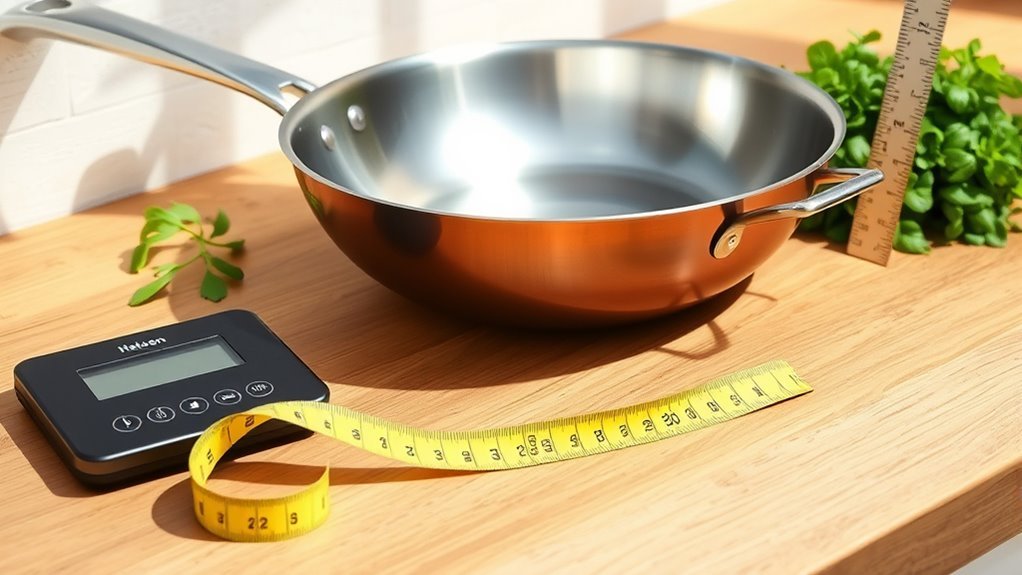
To measure a round frying pan correctly, start by placing it on a flat, stable surface to prevent any movement. Use your measuring tools, like a ruler or measuring tape, to measure the inner rim diameter across the widest part of the pan, avoiding handles.
This ensures you measure accurately and get a consistent measurement each time. Record the diameter in inches or centimeters as per your pan size guide.
| Step | Action | Tip |
|---|---|---|
| 1 | Place pan on flat surface | Prevents movement |
| 2 | Measure inner rim diameter | Measure across center |
| 3 | Record measurement | Use consistent units |
Following these steps guarantees precise frying pan measurement every time.
Measuring Different Frying Pan Shapes: Square and Oval
Although measuring round pans is straightforward, square and oval frying pans require a slightly different approach.
For a square frying pan, you’ll want to gauge the internal dimensions by checking the distance across the inside from one internal edge to the opposite edge, both horizontally and vertically.
Use a measuring tape to capture both width and length accurately.
When dealing with an oval frying pan, measure the widest point across the shorter side and the longest point along the longer side.
This shape measurement guarantees you get the accurate size, especially with irregular shapes.
Always measure from the internal edges, excluding handles or outer rims, to understand the true pan dimensions.
Using a flexible measuring tape helps maintain precision for these non-round pans.
How Pan Dimensions Affect Cooking Performance
When you choose the right pan size, you’ll notice your food cooks more evenly and efficiently. Pan dimensions directly influence heat distribution and cooking performance. Measuring frying pan diameter helps ensure stove compatibility, allowing uniform heat transfer and better heat retention.
A larger diameter increases the cooking surface area, letting you cook multiple ingredients without overcrowding, which improves texture and flavor by preventing steaming. On the other hand, a smaller pan limits surface area, reducing cooking efficiency and risking uneven heat.
Properly measuring your frying pan guarantees your pan matches recipe needs and cooking methods, optimizing cooking times and results. Understanding pan dimensions empowers you to select the best pan for your stove and dishes, enhancing overall cooking performance every time.
Frequently Asked Questions
How Is Frying Pan Size Measured?
You measure frying pan size by placing a ruler across the inner rim’s widest part, passing through the center. Make sure the pan’s on a flat surface.
Record the diameter in inches, rim to rim, excluding the handle.
How Big Is a 7 Inch Frying Pan?
You might expect a 7-inch frying pan to be small, but it measures about 7 inches across the top rim, with a cooking surface around 4.5 to 5 inches—perfect for quick, single-serving meals.
Are Pans Measured by Base or Top?
You measure pans by the top rim, not the base.
The diameter from one inner edge across to the opposite inner edge gives you the accurate size, since the base is usually smaller due to pan design.
How Do I Tell the Size of My Pan?
You tell your pan’s size by measuring its diameter across the top inner rim, edge to edge, on a flat surface.
Don’t include the handle—just measure the widest part through the center for accuracy.
Conclusion
Now that you know how to measure your frying pan like a pro, you’ll always hit the cooking bullseye. Think of your pan’s size as the secret ingredient that spices up every dish—too big or small, and the flavor dance falters.
With just a tape and a steady hand, you’re ready to master the perfect fit. This turns your kitchen into a stage where every meal steals the spotlight.
Happy cooking adventures await! Remember, accurately measuring your frying pan size ensures better heat distribution and cooking results every time.